
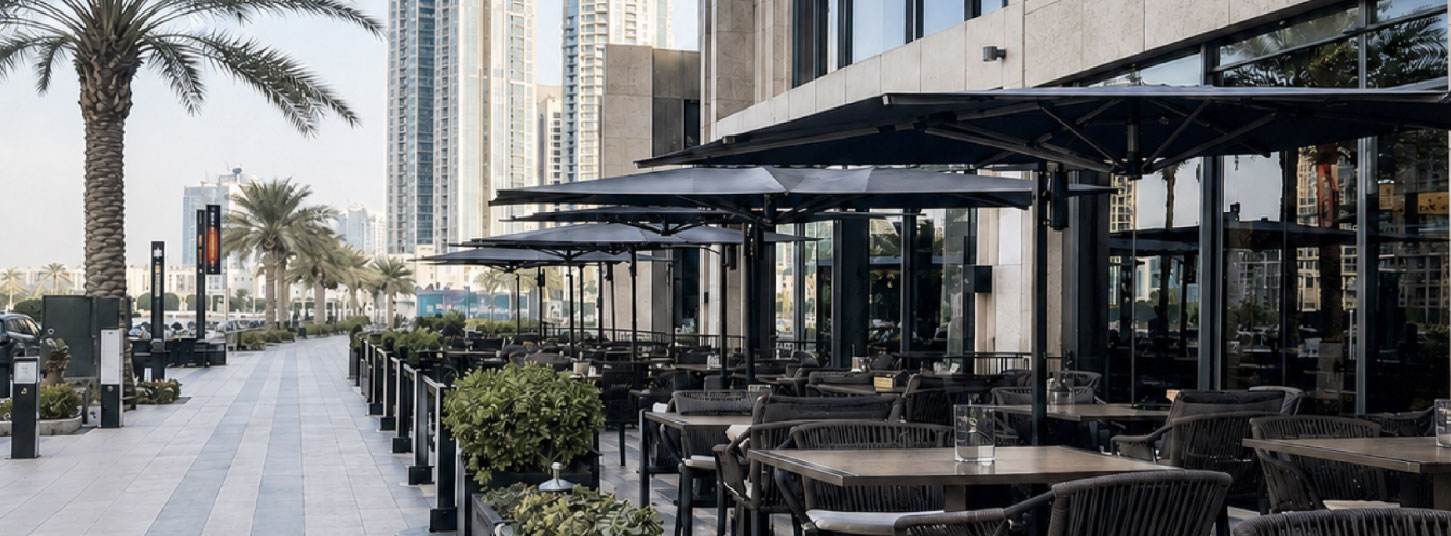
To enhance quality of life, preserve the city’s urban and aesthetic appearance, and provide a safe and orderly environment for pedestrians and visitors to commercial establishments, Abu Dhabi City Municipality conducted an awareness campaign on the requirements governing outdoor seating areas and pavement occupancy. The campaign targeted owners of shops, cafés, restaurants and other relevant establishments.
The campaign aimed to raise awareness of the requirements and standards governing outdoor seating areas and explain the procedures and regulations that must be observed when using pavements and outdoor spaces adjacent to establishments. It also sought to strengthen establishment owners’ responsibility for maintaining the cleanliness of these areas, preventing any practices that could detract from the urban landscape, and complying fully with the areas and boundaries authorised for use.
The Municipality emphasised the need to obtain the required permits before establishing any outdoor seating area or occupying a pavement and to comply with the areas and boundaries approved under the permit. The seating area must be located on the pavement immediately adjoining the establishment, must not extend beyond the length of the corresponding shopfront, and must be at least one metre wide.
The Municipality stressed the importance of keeping pedestrian routes free from obstructions and refraining from placing tables, chairs or equipment in a manner that impedes public movement or affects building entrances and exits, entrances to car parks, emergency exits, or access for Civil Defence and emergency vehicles.
During the campaign, Municipality inspectors ensured that the targeted groups were made aware of the applicable requirements. These include maintaining a distance of at least eight metres from the entrances to residential buildings; three metres from infrastructure service installations, such as electricity rooms and substations and telecommunications towers; and two metres from entrances to underground car parks, emergency areas, bus stops and points where pedestrian routes intersect with roads. A safe distance must also be maintained at road junctions to preserve clear visibility and ensure the safety of motorists and pedestrians.
A distance of at least one metre must also be maintained from street-lighting columns, directional signs, parking payment machines, tree pits, fire hydrants and other road elements and equipment. Appropriate pedestrian access routes must be provided through extended seating areas, particularly where an outdoor seating area exceeds 12 metres in length, to ensure that movement remains safe and unobstructed.
With regard to outdoor seating equipment, the Municipality explained that seating areas may not be fully enclosed by fencing or partition walls. Easily movable and portable barriers may be used, provided that they do not exceed 1.20 metres in height. Movable planters may also be used in accordance with the approved requirements, provided that their cleanliness and appearance are properly maintained.
Parasols must be sturdy, safe, movable and portable. They must be at least 2.20 metres high and must neither extend beyond the boundaries of the authorised area nor obstruct pedestrian movement. They must also be closed and removed during strong winds. Tables and chairs must be safe and easy to move and must not pose any risk or obstruction to pavement users.
The Municipality further emphasised that seating equipment must be appropriate to the character of the location and must neither cause visual blight nor inconvenience users. It also highlighted the importance of maintaining the cleanliness of outdoor seating areas, furniture, parasols, barriers and surrounding plants; refraining from leaving waste, materials or unused equipment in public spaces; and avoiding any alterations to pavements or the installation of unauthorised platforms, flooring or utility connections that could affect infrastructure or the city’s appearance.
Abu Dhabi City Municipality called upon owners of shops, cafés and restaurants to cooperate and comply with the approved requirements and permits. It affirmed that the proper regulation of outdoor seating areas is a shared responsibility that contributes to providing a safe and orderly urban environment, safeguarding pedestrians’ rights, enhancing the beauty of the city, and reinforcing standards of cleanliness, safety and quality of life in a manner befitting Abu Dhabi and its residents and visitors.